> For the complete documentation index, see [llms.txt](https://docs.kiloiot.io/llms.txt). Markdown versions of documentation pages are available by appending `.md` to page URLs; this page is available as [Markdown](https://docs.kiloiot.io/kilo-docs-es/kilo-iot-server/connectors/tracker-connector.md).
# Conector Tracker
Conecta rastreadores OBD2, CAN bus y GPS mediante el conector Tracker — más de 2.000 modelos preconfigurados.
El conector Tracker permite que el servidor Kilo IoT acepte datos de rastreadores de vehículos — dispositivos de seguimiento vehicular GPS independientes, OBD2 y bus CAN. El servidor incluye plantillas preconfiguradas para más de 2.000 modelos de rastreadores de vehículos.
## Añadir el conector Tracker
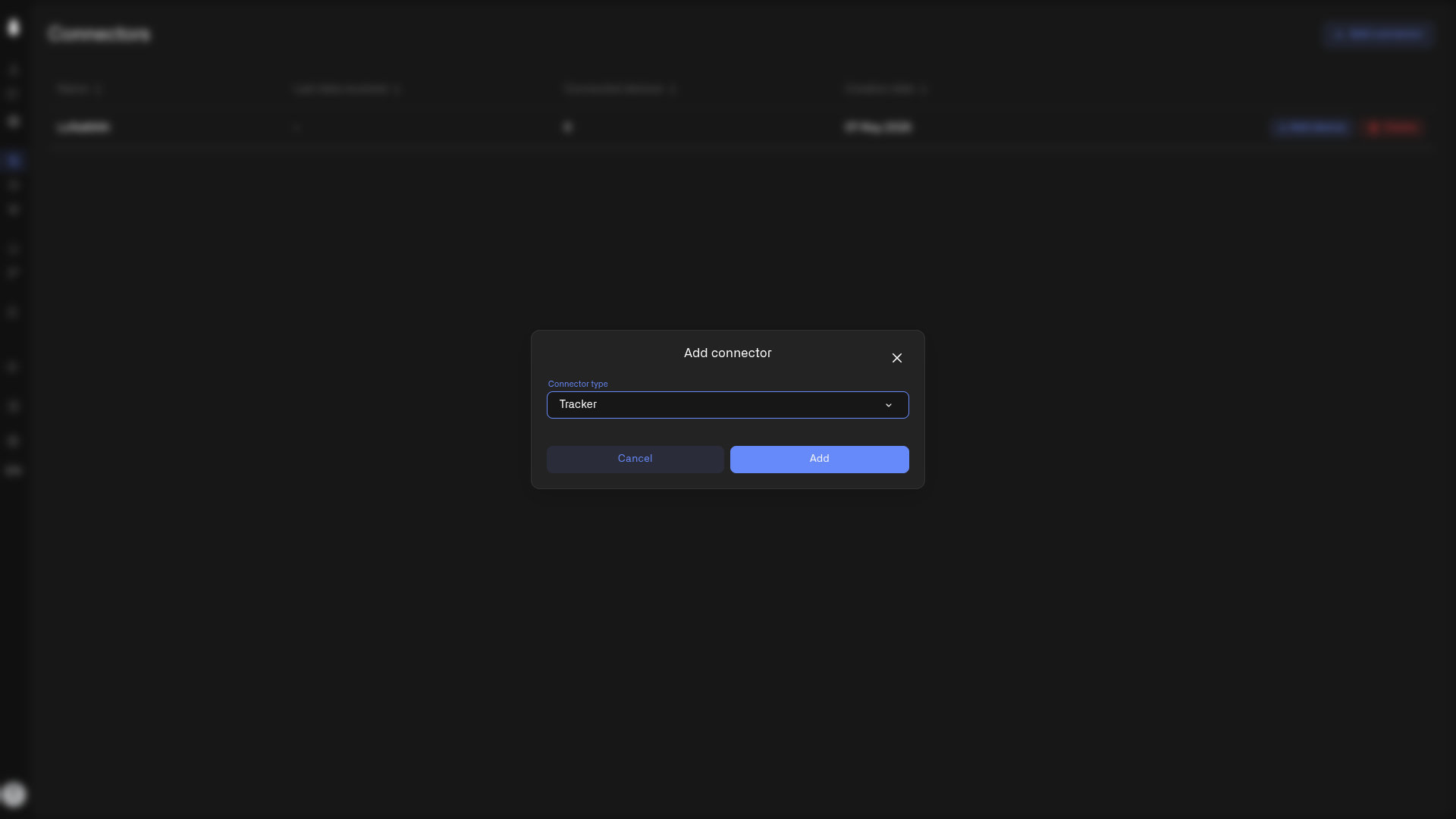
1. Navegue a **Conectores** en la barra lateral.
2. Haz clic en **Agregar conector**.
3. En el **Tipo de conector** lista desplegable, seleccione **Tracker**.
4. Haz clic en **Añade**.
El conector se crea inmediatamente. Cada organización solo puede tener un conector Tracker.
## Dentro del conector Tracker
Haga clic en la fila del conector Tracker en la tabla de conectores para abrirlo. Esto muestra la lista compartida de dispositivos. Al registrar un dispositivo a través del conector Tracker, la **Conexión** pestaña incluye campos específicos del rastreador: **ID único**, **Modelo del dispositivo**, y una **URL para el rastreador GPS** punto final.
Para el registro y la gestión de dispositivos, consulte [Registro de dispositivos](/kilo-docs-es/kilo-iot-server/devices/registering-devices.md) y [Gestión de dispositivos](/kilo-docs-es/kilo-iot-server/devices/device-management.md).
---
# Agent Instructions
This documentation is published with GitBook. GitBook is the documentation platform designed so that both humans and AI agents can read, navigate, and reason over technical content effectively. Learn more at gitbook.com.
## Querying This Documentation
If you need additional information that is not directly available in this page, you can query the documentation dynamically by asking a question.
Perform an HTTP GET request on the current page URL with the `ask` query parameter, and the optional `goal` query parameter:
```
GET https://docs.kiloiot.io/kilo-docs-es/kilo-iot-server/connectors/tracker-connector.md?ask=&goal=
```
`ask` is the immediate question: it should be specific, self-contained, and written in natural language.
`goal` is optional and describes the broader end goal you are ultimately trying to accomplish on behalf of the user. GitBook uses it to tailor the answer towards what is most useful for that goal.
The response will contain a direct answer to the question and relevant excerpts and sources from the documentation.
Use this mechanism when the answer is not explicitly present in the current page, you need clarification or additional context, or you want to retrieve related documentation sections.