> For the complete documentation index, see [llms.txt](https://docs.kiloiot.io/llms.txt). Markdown versions of documentation pages are available by appending `.md` to page URLs; this page is available as [Markdown](https://docs.kiloiot.io/kilo-docs-pt/kilo-iot-server/connectors/tracker-connector.md).
# Conector de Rastreador
Ligue rastreadores OBD2, CAN bus e GPS através do conector Tracker — mais de 2000 modelos pré-configurados.
O conector Tracker permite que o Servidor IoT Kilo aceite dados de localizadores de veículos — dispositivos de rastreamento de veículos OBD2, barramento CAN e GPS autónomos. O servidor inclui modelos pré-configurados para mais de 2.000 modelos de localizadores de veículos.
## Adicionar o conector Tracker
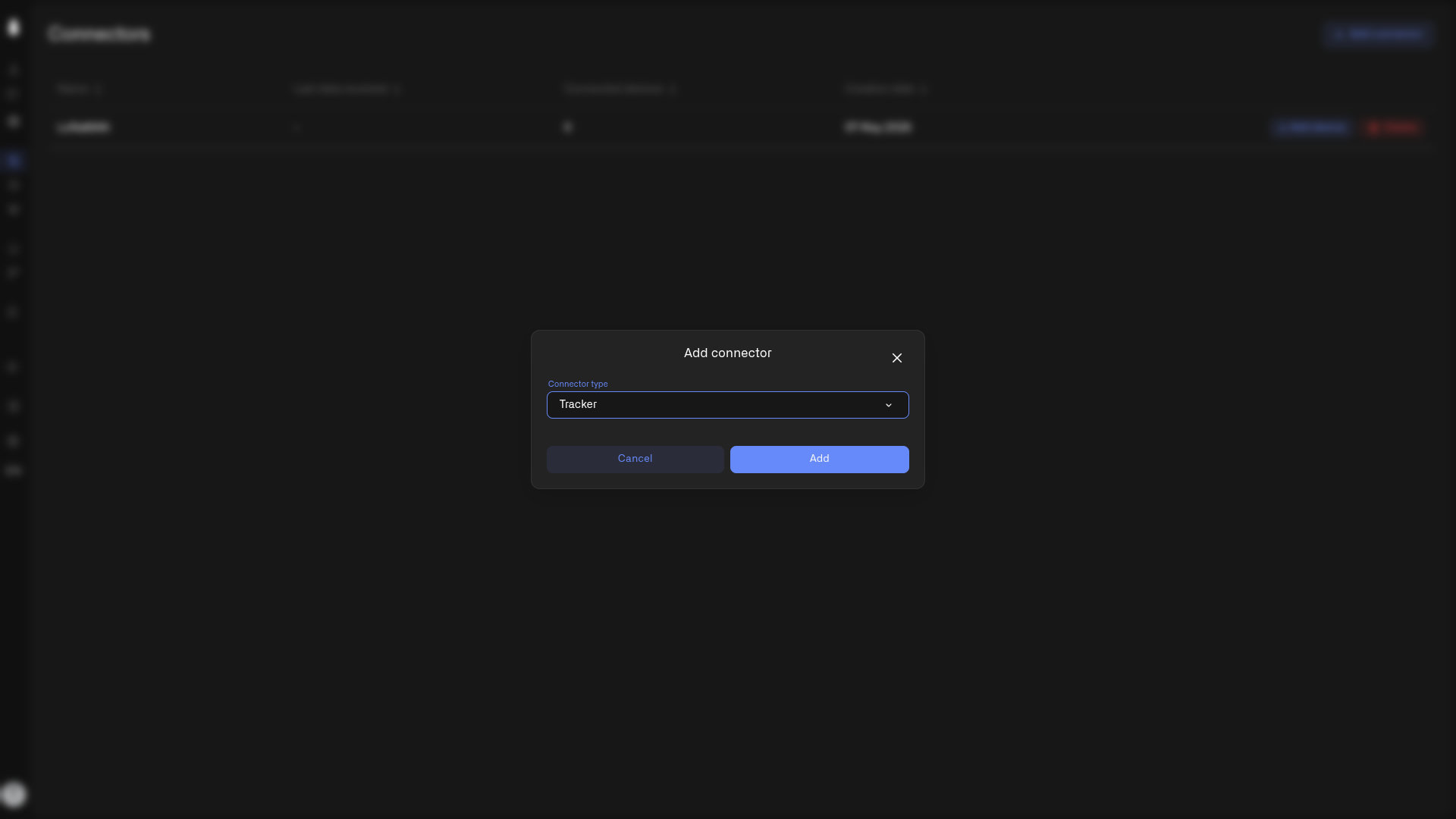
1. Navegue até **Conectores** na barra lateral.
2. Clique em **Adicionar conector**.
3. No **tipo de conector** menu suspenso, selecione **Tracker**.
4. Clique em **Adicionar**.
O conector é criado imediatamente. Cada organização pode ter apenas um conector Tracker.
## No interior do conector Tracker
Clique na linha do conector Tracker na tabela de conectores para o abrir. Isto mostra a lista de dispositivos partilhada. Ao registar um dispositivo através do conector Tracker, o **Ligação** separador inclui campos específicos do localizador: **ID exclusivo**, **Modelo do dispositivo**, e um **URL para localizador GPS** endpoint.
Para registo e gestão de dispositivos, consulte [Registo de Dispositivos](/kilo-docs-pt/kilo-iot-server/devices/registering-devices.md) e [Gestão de Dispositivos](/kilo-docs-pt/kilo-iot-server/devices/device-management.md).
---
# Agent Instructions
This documentation is published with GitBook. GitBook is the documentation platform designed so that both humans and AI agents can read, navigate, and reason over technical content effectively. Learn more at gitbook.com.
## Querying This Documentation
If you need additional information that is not directly available in this page, you can query the documentation dynamically by asking a question.
Perform an HTTP GET request on the current page URL with the `ask` query parameter, and the optional `goal` query parameter:
```
GET https://docs.kiloiot.io/kilo-docs-pt/kilo-iot-server/connectors/tracker-connector.md?ask=&goal=
```
`ask` is the immediate question: it should be specific, self-contained, and written in natural language.
`goal` is optional and describes the broader end goal you are ultimately trying to accomplish on behalf of the user. GitBook uses it to tailor the answer towards what is most useful for that goal.
The response will contain a direct answer to the question and relevant excerpts and sources from the documentation.
Use this mechanism when the answer is not explicitly present in the current page, you need clarification or additional context, or you want to retrieve related documentation sections.