> For the complete documentation index, see [llms.txt](https://docs.kiloiot.io/llms.txt). Markdown versions of documentation pages are available by appending `.md` to page URLs; this page is available as [Markdown](https://docs.kiloiot.io/kilo-iot-server/devices/metric-templates.md).
# Metrics
Find, create, and manage the shared metrics that give device readings consistent names, units, and data types across Kilo.
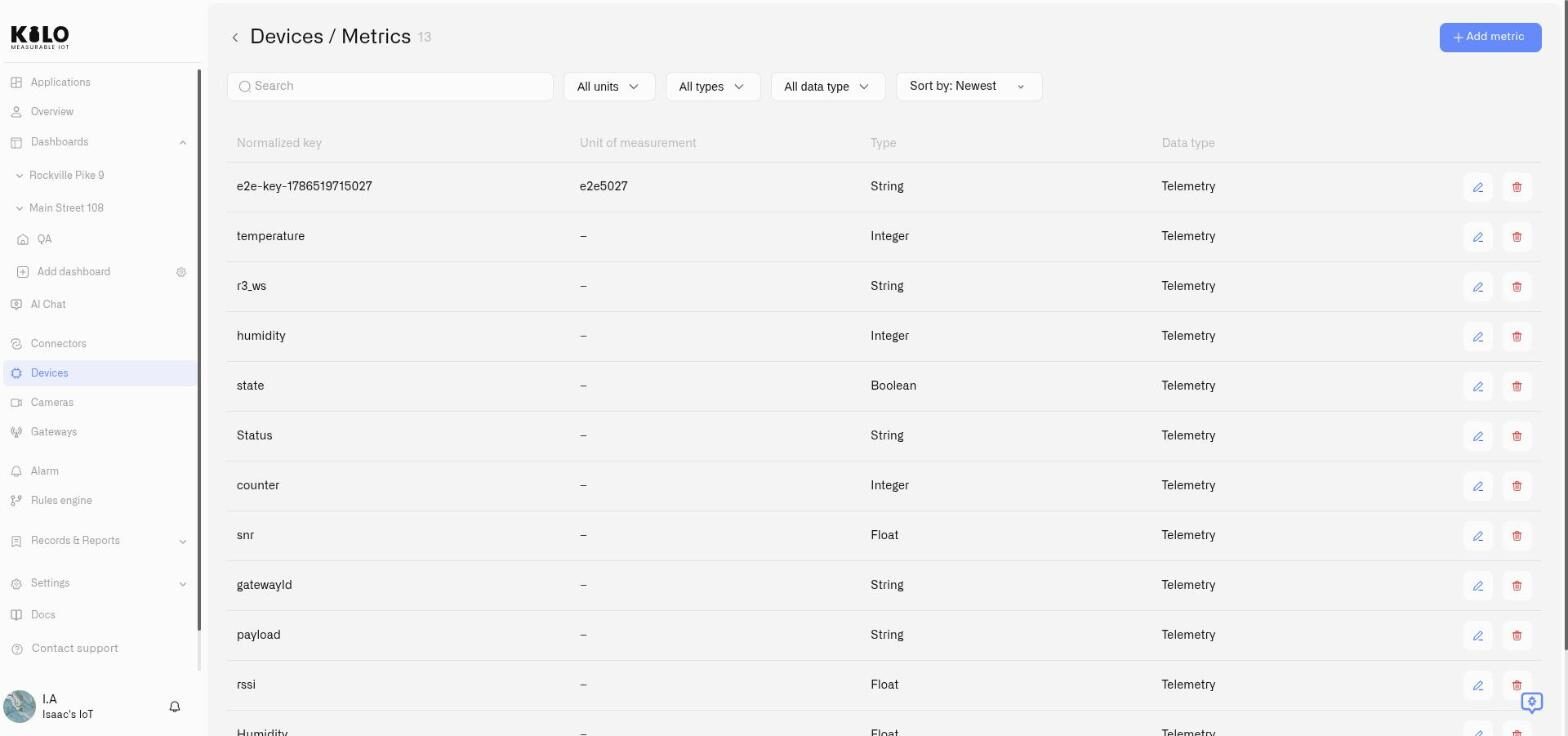
A metric tells Kilo what a device reading means and how to store it. It combines a **normalized key**, such as `temperature`, with a unit, value type, and data type.
The two type fields answer different questions: **Data type** says whether the information is telemetry, device metadata, or a custom attribute; **Type** says whether its value is stored as a Float, Integer, String, or Boolean.
This shared definition lets devices from different manufacturers use the same dashboards and rules. One device may send `temp_c` and another may send `t_celsius`; mapping both raw keys to the `temperature` metric gives Kilo one consistent reading to work with.
## Open the metric catalog
Go to **Devices → Metrics**.
The list contains every metric available to your organization. Each row shows its normalized key, unit of measurement, value type, and data type.
Use the controls above the list to find a metric:
* **Search** matches the normalized key.
* **All units** filters by unit and includes metrics without a unit. Select the units and click **Apply**.
* **All types** filters by String, Integer, Float, or Boolean and applies immediately.
* **All data type** filters by Telemetry, Device metadata, or Custom attributes and applies immediately.
* **Sort by** orders metrics by **Newest** or **Oldest**.
The unit, type, and data-type filters accept several values at once.
Metrics created by your organization provide **Edit** and **Delete** actions. Metrics supplied by Kilo do not, because their definitions are shared across deployments.
## Create a metric
1. Go to **Devices → Metrics**.
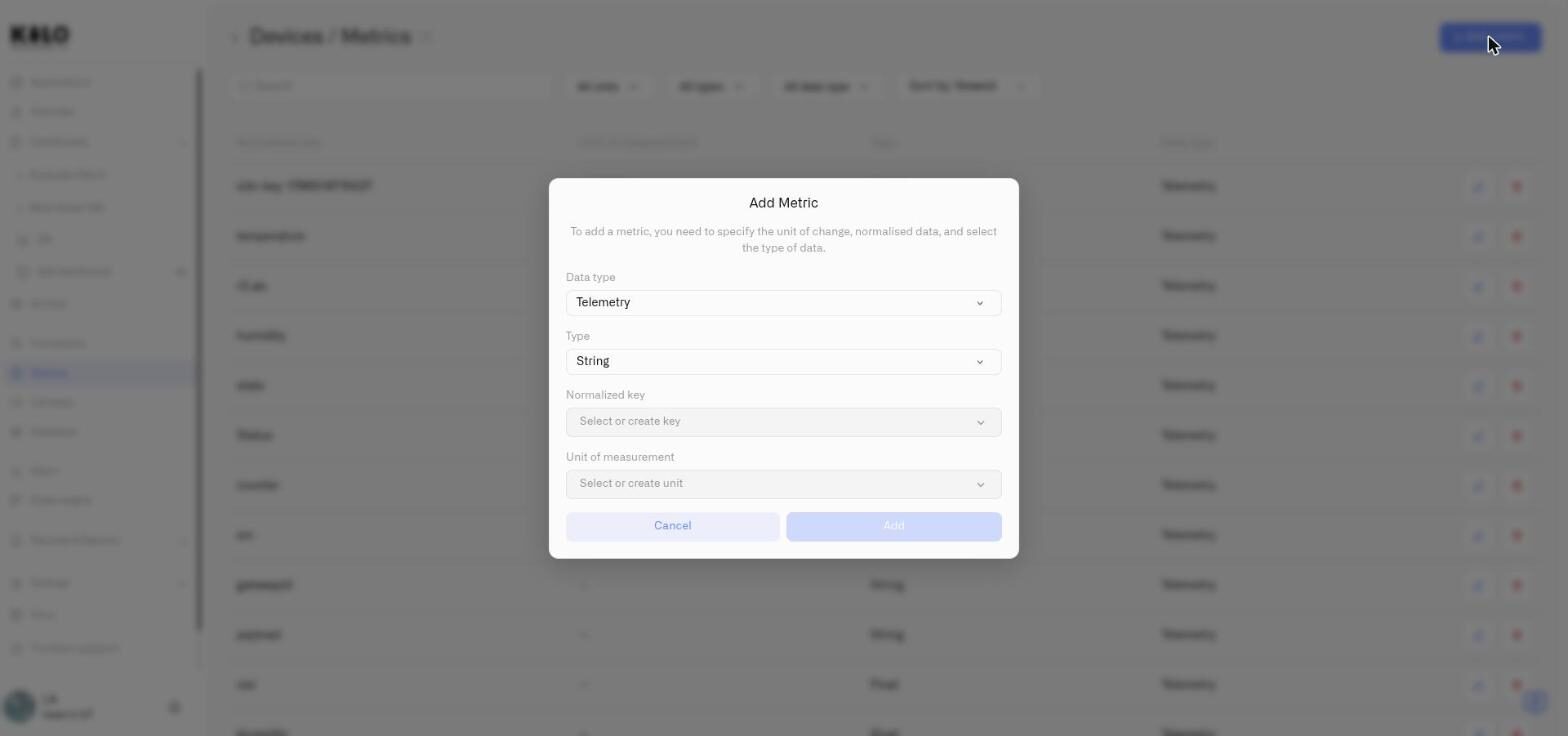
2. Click **Add metric**.
3. Complete the four fields in the **Add Metric** dialog.
4. Click **Add**.
### Data type
Choose what kind of information the metric represents:
| Data type | Use it for | Examples |
| --------------------- | ------------------------------------------- | -------------------------------------------------- |
| **Telemetry** | Readings that change over time | Temperature, humidity, battery level, pressure |
| **Device metadata** | Information the device reports about itself | Firmware version, hardware revision |
| **Custom attributes** | Information your organization adds | Installation date, asset tag, maintenance interval |
Only Telemetry metrics appear when mapping incoming device readings. Device metadata and Custom attributes are not offered as telemetry mappings.
### Type
Choose how Kilo stores the value:
| Type | Use it for | Examples |
| ----------- | --------------------- | ----------------------------- |
| **Float** | Numbers with decimals | `22.5`, `67.3`, `3.28` |
| **Integer** | Whole numbers | `85`, `-120`, `42` |
| **String** | Text | `"open"`, `"standby"` |
| **Boolean** | True or false | Motion detected, alarm active |
Chart widgets and the gauge-style Last Data displays require an Integer or Float metric. The Last Data **Value** display can also show text and Boolean values.
### Normalized key
The normalized key is the standard name for the measurement, independent of the raw name sent by a device.
Open **Normalized key** and either select an existing key or choose **Create a new normalized key**. Use a descriptive name such as `soil_moisture`, not a device-specific name such as `sensor_3_value`. Lowercase names with underscores keep the catalog consistent.
Each normalized key can belong to only one metric. If the selected key is already in use, the form reports **A metric with this normalized key already exists**.
Normalized keys are created, renamed, and deleted from this field. Keys supplied by Kilo cannot be renamed or removed.
### Unit of measurement
Select the unit displayed beside the value, such as °C, %, lx, or mV. Choose an existing unit or select **Create a new unit** and enter the symbol exactly as it should appear.
A unit is required for Telemetry. It is optional for Device metadata and Custom attributes, where values such as a firmware version or asset tag may not have a unit.
Units are created, renamed, and deleted from this field. Units supplied by Kilo cannot be renamed or removed.
## Edit a metric
Metrics are shared across your organization, not configured separately for each device. Editing a metric changes the definition for every device mapped to it.
1. Find the metric under **Devices → Metrics**.
2. Click **Edit**.
3. Update the required fields.
4. Click **Save**.
5. Review the confirmation describing the organization-wide effect and confirm the change.
If only one device needs a different definition, create a new metric and remap that device instead of editing the shared metric.
## Delete a metric
Click **Delete** on a metric created by your organization and confirm the action.
Kilo refuses to delete a metric that is still mapped to a device. Remove the mapping from every device that uses it, then try again.
## Map a device reading to the metric
Creating a metric does not connect it to a device automatically. Open the device's **Metrics** tab and map the raw key sent by the device to the normalized metric.
After several device types map their raw temperature keys to `temperature`, the same dashboard widget, rule, or query can use all of them without manufacturer-specific logic.
## Troubleshooting
| Problem | What to check |
| ----------------------------------------------------------------- | ------------------------------------------------------------------------------ |
| A metric is missing from a chart or gauge-style Last Data display | Confirm its **Type** is Integer or Float and the device sends a numeric value. |
| A metric is missing from a device mapping | Confirm its **Data type** is Telemetry. |
| A normalized key cannot be selected | Another metric may already use it. Search the catalog for that key. |
| Edit and Delete are unavailable | The metric, key, or unit was supplied by Kilo and cannot be changed. |
| Delete is refused | Remove the metric from every device mapping before deleting it. |
## See also
* [Registering Devices](/kilo-iot-server/devices/registering-devices.md) — map raw device data during registration
* [Device Management](/kilo-iot-server/devices/device-management.md) — change mappings on an existing device
* [Chart Widget](/kilo-iot-server/dashboards/adding-widgets/chart-widget.md) — display numeric metrics over time
---
# Agent Instructions
This documentation is published with GitBook. GitBook is the documentation platform designed so that both humans and AI agents can read, navigate, and reason over technical content effectively. Learn more at gitbook.com.
## Querying This Documentation
If you need additional information that is not directly available in this page, you can query the documentation dynamically by asking a question.
Perform an HTTP GET request on the current page URL with the `ask` query parameter, and the optional `goal` query parameter:
```
GET https://docs.kiloiot.io/kilo-iot-server/devices/metric-templates.md?ask=&goal=
```
`ask` is the immediate question: it should be specific, self-contained, and written in natural language.
`goal` is optional and describes the broader end goal you are ultimately trying to accomplish on behalf of the user. GitBook uses it to tailor the answer towards what is most useful for that goal.
The response will contain a direct answer to the question and relevant excerpts and sources from the documentation.
Use this mechanism when the answer is not explicitly present in the current page, you need clarification or additional context, or you want to retrieve related documentation sections.